LDDA High Streets Amendment Passes
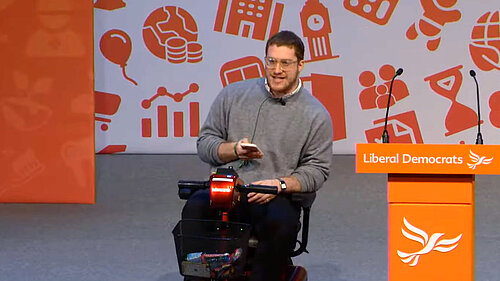
LDDA's amendment to Lib Dem policy passed this morning - boosting a motion on revitalising town centres by highlighting making them welcoming to more people through disabled parking spaces and accessible public toilets.
Our amendment to the party policy motion “Revitalising Town Centres and High Streets” presented at Party Conference in York - passed clearly.
Liberal Democrat Disability Association Chair Katharine Macy proposed the amendment and it was summated by exec member Jonah Weisz (pictured).
The amendment to the motion, “Revitalising Town Centres and High Streets (Town Centres and High Streets Policy Paper)” as proposed by LDDA read:
After 3. e) (Line 76), insert:
f) Encouraging the provision of blue badge spaces, with a minimum
requirement of 5 per cent of car parking spaces or one space
being blue badge designated as per the British Standards
Institution.
g) Encouraging the provision of family and child car parking spaces.
h) Re-establishing public toilets in town centres.
This would sit in the original motion as shown in bold below:
F8 Revitalising Town Centres and High Streets (Town Centres and High Streets Policy Paper)
Federal Policy Committee
Mover: Daisy Cooper MP (Spokesperson for the Treasury) Summation: Cllr Katie Mansfield (Chair of the Policy Working Group)
1 Conference understands that town centres and high streets are
2 the beating heart of communities up and down the country, places
3 that people love and become attached to, places that give a sense
4 of local pride and places that can support local economic, social
5 and environmental needs.
6 Conference recognises that many town centres and high streets
7 have been allowed to go into disrepair, with empty shops, cracked
8 pavements, traffic jams and waste strewn across the streets.
9 Conference believes that, to create a successful town centre, it
10 must be:
11 A. Fair: Welcoming spaces that are socially inclusive and
12 accessible to everyone.
13 B. Economically Successful: Places that feel alive with opportunity,
14 where independent businesses thrive day and night, weekday
15 and weekend and resilience is built through a diversity of uses.
16 C. Social: An opportunity to connect, for all ages and
17 backgrounds, with activities and infrastructure that supports
18 health, wellbeing and community pride.
19 D. Local: Rooted in the needs of local people, supporting local
20 businesses, and creating meaningful jobs, especially for young
21 people building their futures.
22 E. Sustainable: Designed for the future, with clean transport
23 options, green spaces and inbuilt climate resilience.
24 F. Clean and Safe: Environments where people feel secure and
25 comfortable spending time and where businesses have the
26 confidence to locate.
27 Conference wishes to reimagine town centres, not as relics of the
28 past but as places for everyone to live, connect and belong, places
29 that inspire local pride today and for generations to come.
30 Conference therefore endorses the policies set out in policy paper
31 162, Revitalising Town Centres and High Streets, and in particular
32 welcomes its proposals to:
33 1. Reduce vacancy rates by:
34 a) A temporary emergency cut to VAT for hospitality,
35 accommodation and attractions.
36 b) A review of the cumulative effects of taxation on the High
37 Street.
38 c) Improving access to competitive energy deals.
39 d) Reforming business rates to reward occupancy and
40 community value.
41 e) Requiring landlords, especially these from overseas, to
42 publish contact details and a named contact in the UK.
43 f) Strengthening the 'Town Centre First' principle in national
44 planning policy, including an 'Out of Town Levy'.
45 g) Encouraging homes above shops.
46 2. Create the spaces the community wants on- and offline by:
47 a) Making it easier to convert vacant units into community
48 hubs, without full planning change of use.
49 b) Creating a national digital infrastructure designed to
50 support local enterprise, a platform that can be available
51 for local adaptations and branding.
52 c) Giving councils powers to designate Independent Shop
53 Zones within their local plan, locally defined areas that
54 protect and champion small, locally-owned businesses.
55 d) Closing loopholes that incentivise landlords to lease
56 property to shell companies or businesses with no credible
57 trading activity, and tighten anti-money laundering (AML)
58 duties for commercial lettings, requiring landlords and
59 agents to carry out proportional, risk-based AML checks.
60 3. Create distinctive design and better accessibility by:
61 a) Promoting public transport and active travel options.
62 b) Reviewing the impact of parking charges to provide
63 guidance for councils to support more flexible, targeted
64 approaches that can support footfall, in particular during
65 evenings and weekends.
66 c) Making dedicated funds available for local authorities that
67 want to deliver high-quality high street pedestrianisation
68 projects.
69 d) Establishing a National Centre for Design and Placemaking
70 to support local authorities through providing design
71 support, guidance and training for local authorities,
72 championing good design and sustainability across all
73 regions.
74 e) Initiating an annual national 'Amazing High Streets'
75 competition to celebrate the outstanding design of public
76 spaces.
f) Encouraging the provision of blue badge spaces, with a minimum
requirement of 5 per cent of car parking spaces or one space
being blue badge designated as per the British Standards
Institution.
g) Encouraging the provision of family and child car parking spaces.
h) Re-establishing public toilets in town centres.
77 4. Drive footfall and bring high streets to life by:
78 a) Establishing a High Street Culture and Community Fund
79 delivered in partnership with the Arts Council and local
80 authorities to give ongoing support to community-led
81 cultural initiatives and local events.
82 b) Establishing a national Incubator Fund to support the
83 creation and early-stage development of locally designed
84 festivals.
85 c) Backing creative start-ups and cultural enterprises.
86 5. Tackle the lack of sustainable investment by:
87 a) Establishing High Street Improvement Districts (HSIDs) led
88 by a locally- agreed board representing the cross section of
89 interests, including representation from the local council,
90 which would be charged with creating a long term vision for
91 the town centre, supported with a joined-up roadmap,
92 curator and communication plan.
93 b) Creating a 'High Streets Back Home' scheme as a defined
94 and accessible route for people to give back, to invest in the
95 future of their community, whether by supporting
96 community asset purchases, restoring heritage buildings or
97 backing local enterprise space.
98 6. Tackle safety, anti-social behaviour and shop theft by:
99 a) Building features that discourage anti-social behaviour
100 (such as strategic lighting) into the design of town centres.
101 b) Supporting small businesses to invest in CCTV.
102 c) Offering digital tools as collective procurement bundles,
103 making them accessible for small businesses, such as a
104 WhatsApp instant alert system for businesses, Business
105 Improvement District teams, and community wardens that
106 flags offenders, patterns and risks in real time.
107 d) Calling on the National Crime Agency to establish a
108 dedicated unit to liaise with local authorities and police
109 forces to take on organised shoplifting gangs.